
Microwave Fuse Keeps Blowing When You Start It? [8 Common Reasons & Fixes!]

Has your microwave suddenly stopped working? No lights, no beeps, no nothing? Chances are it’s the fuse, but what do you do when the microwave fuse keeps blowing?
A microwave fuse that keeps blowing indicates a problem with the power flow. It may be a failure in the high voltage capacitor, a defective magnetron, or faulty door switches – all of which will require you to disassemble the microwave to attempt repair – or unwanted water in your appliance. Finally, the problem may be a fault with the outlet.
Keep reading to learn more about the common causes for your microwave oven fuse to blow repeatedly and how to replace it. I’ll also give some tips on how to tell if it’s worth attempting the repair or if it’s time for a replacement.
Note: There is a high risk of electric shocks when repairing a microwave. Some components retain dangerous voltages even after the microwave is disconnected from the wall outlet. Only proceed with the repairs if you can safely work and repair microwaves.
Why does my microwave fuse keep blowing?
Most microwaves, like other electrical appliances, contain several types of fuses, all of which are designed to protect either the user or the appliance – or both – from things like a power surge or broken equipment. Unfortunately, the design of this safety measure means that you might end up blowing a fuse if you have another problem going on.
Determining which fuse keeps blowing will go a long way toward figuring out why it keeps happening and ensuring the safe operation of your microwave down the road.
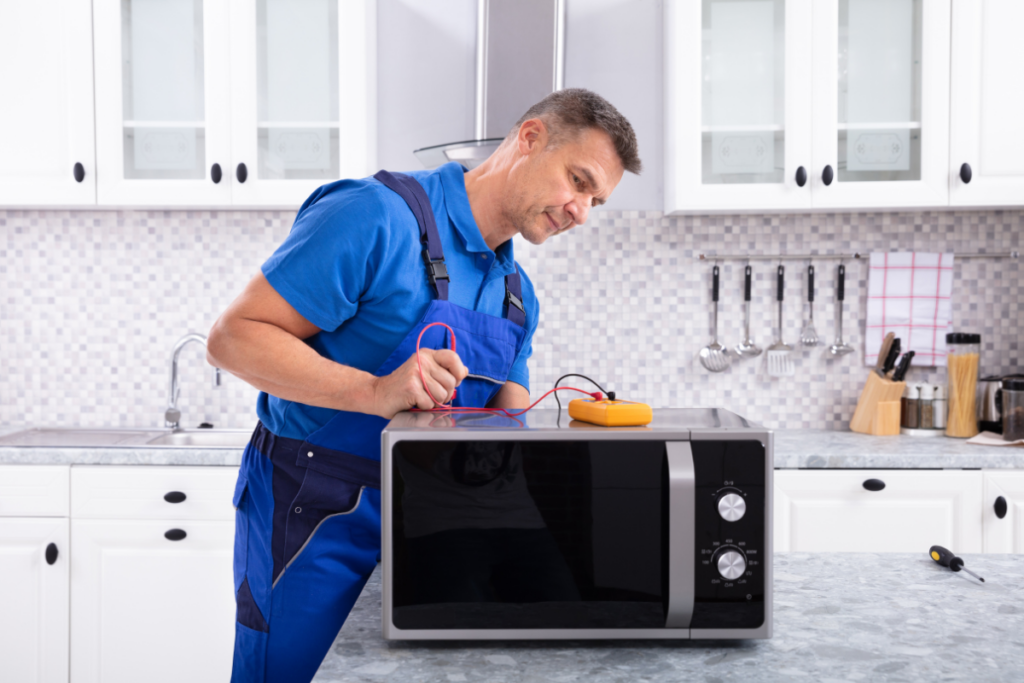
If the microwave fuse keeps blowing, it is probably for one of these eight reasons:
- High voltage capacitor failure
- High voltage diode failure
- Defective magnetron
- Cooling fan failure
- Defective door switch
- Incorrect or underpowered fuse
- Water in the motor
- Faulty power outlet or tripped circuit breaker
Let’s take a thorough look at each of these causes and what you can do to fix them.
Related: RV Fridge Keeps Blowing Fuses? Follow These Simple Steps
High voltage capacitor failure
A standard microwave uses a 120V plug, but it actually requires significantly more power to heat your food. To do this, the high voltage capacity helps double the volts of electricity coming in.
When the microwave’s high-voltage capacitor fails, you may hear a loud pop (that’s the built-up power discharging from the power supply), but you may not. Either way, your microwave will not work properly.
There are cases where the capacitor may be going bad, but not yet causing the fuse to blow. In this case, your microwave may turn on and appear to function, but it will not be heating your food.
Diagnosis
There are a couple of different ways to tell if the high-voltage capacitor in your microwave is responsible for the blown fuses, and they all start with unplugging your microwave and removing the cover.
Please note that manufacturers recommend you not attempt this yourself as the capacitor can store enough power to deliver a lethal shock of large amounts of electricity, even after it has failed. If you aren’t 100% that you are capable, it might be a good idea to contact a professional repairman to avoid serious harm.
Safety precautions: Before testing the capacitor, ensure that you have discharged any residual electricity.
Once the capacitor has been discharged and removed, inspect it carefully for signs of physical damage. Electrical burns around the contact points, terminals, or body of the capacitor are a sure sign of damage.
You can also use a digital multimeter to test the capacitor.
Repair
The capacitor is located inside the microwave. You’ll need to remove the microwave housing for easier access. Consult the microwave’s service manual for its location as it may differ for your specific microwave make and model.
Replace the capacitor with another of the same capacity and type it as the original. Once fitted, replace the fuse and check if the fuse stops blowing.
Due to the amount of power that the high-voltage capacitor can hold even days after the microwave has been unplugged, it’s not recommended that you attempt this repair yourself.
High voltage diode failure
The high-voltage diode operates alongside the capacitor to increase the power of your microwave. Specifically, the diode converts the alternating current from the power outlet into a direct current, which effectively doubles the voltage.
When a high-voltage diode begins to fail, it may supply the high-voltage capacitor with an inconsistent flow of electricity, causing the fuse to blow.
It may be initially difficult to distinguish between a capacitor failure and a diode failure. Since the diode can’t be tested with the multimeter, you may end up having to replace the diode to find out if that was actually the problem.
Diagnosis
The good news is that it’s fairly easy to determine if you need to replace the diode simply by looking at it. The bad news is most diodes are fairly difficult to access.
The best way to tell if your diode has been damaged is by visually comparing it to a new diode. To do this, you’ll need to disassemble the microwave and locate the old diode.
This method will vary depending on the type of microwave you have. Consult your owner’s manual for the location of the diode in your microwave.
Top tip: Always unplug your microwave before beginning disassembly!
Repair
Once you’ve located and diagnosed the failed diode, you can install a replacement.
Replace the faulty diode with a new one of the same type. Completely disassemble the microwave before plugging it back in.
Just like with the capacitor, it’s not recommended that you attempt this repair yourself due to the amount of electricity that may be stored in the microwave, even after it has been unplugged.
Also note that you’ll need some basic tools like a screwdriver and pair of needle-nose pliers for the job.
Defective magnetron
The magnetron is the most important part of your microwave and actually generates the micro-waves for which the appliance is named.
If the magnetron has worn out or become damaged, the microwave will not be able to heat your food quickly or effectively. A magnetron may cause the fuse to blow if it is defective or has been installed incorrectly.
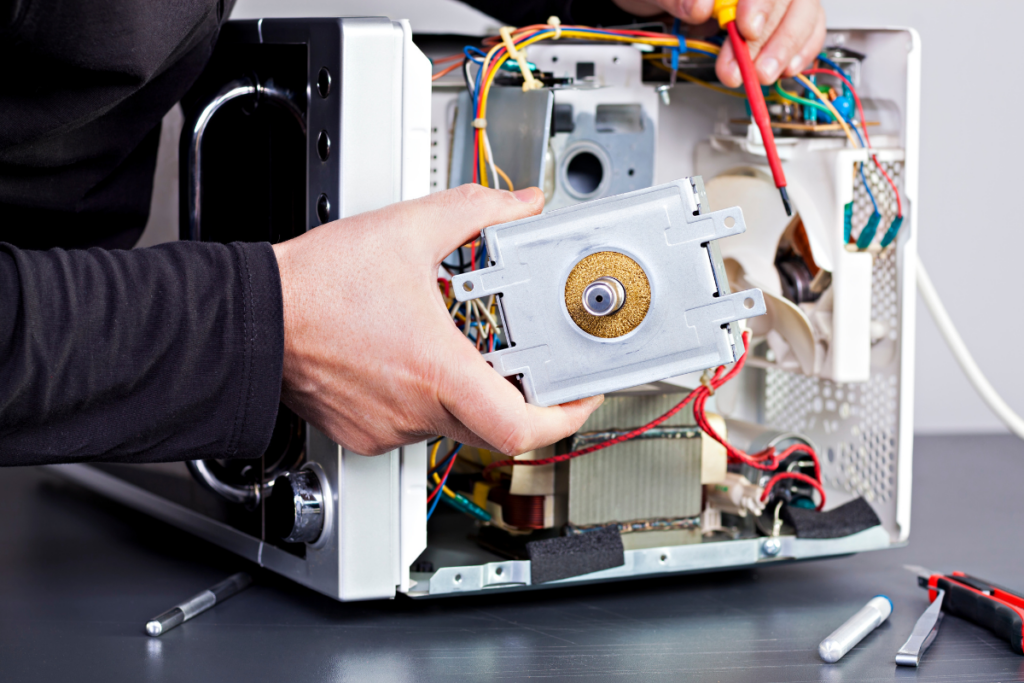
Typically replacing a magnetron is just as costly as replacing the microwave, but you may find yourself wanting to rule out the component as part of your troubleshooting process.
Diagnosis
As with most electrical components, you can test the magnetron using your trusty multimeter.
Typically the magnetron is located just behind the control panel and a few small components. Unplug your microwave and unscrew it, then remove the outer casing. Discharge the capacitor (refer to the high voltage capacitor section for a detailed explanation of how to do this).
The magnetron will be near the back of the appliance and will look like two large metal boxes that are stacked on top of each other. Disconnect any wires or plugs, unscrew the magnetron, and remove it. Use your multimeter to check the magnetron – if the reading is above 1ohm or is “OL,” the magnetron is faulty.
Some microwaves may have more than one magnetron, so make sure to remove and test each of them.
Repair
The magnetron is a large, expensive component in your microwave and may be as much – or even more – than buying a replacement.
If you’ve determined that your magnetron is defective, chances are you’ll be better off replacing the microwave entirely rather than trying to fix it.
Cooling fan failure
The cooling fan is responsible for ensuring that the electronic parts of the microwave don’t overheat.
Your microwave’s cooling fan may be damaged, clogged, or just worn out. If this happens, the electrical components may overheat, causing the microwave’s thermal fuse to trip.
Make sure you’re wiping down your microwave (front and back) regularly to keep dust, grease, and debris from building up and damaging the fan.
Diagnosis
Cooling might not be the first thing that comes to mind when you think about your microwave, but the cooling fan is a necessary part of your appliance – especially if you have an over-the-range microwave!
To determine if a clogged or damaged cooling fan is causing your microwave fuse to blow, take note of whether or not you can hear the fan coming on. You may also be able to observe that it’s visually clogged or damaged.
A fan that is still running, but not operating at full capacity may make a vibrating sound.
Repair
Replacing the microwave’s cooling fan is easier than it sounds, providing you have easy access to the microwave – this may not always be true in the case of those located directly above the oven.
To replace your microwave’s cooling fan, unplug the appliance. Using your owner’s manual, locate the current fan and disassemble the fan assembly. Remove the fan cover and the old fan blade. Screw a new one of the same type in place. Completely reassemble the microwave before plugging it back in.
You may also want to take a dry cloth and carefully wipe down the area if there is grease or dust buildup.
Defective door switch
Microwaves turn off automatically when the door is opened and won’t operate until it’s closed.
Does your microwave keep blowing the fuse when the door opens?
In the case of a defective door switch, not only is the appliance not able to identify when the door is or isn’t properly closed, it may also cause a fuse to blow.
This is a fairly common culprit (especially if you have kids that like to get rough with the microwave) and depending on your microwave type, this might be a pretty simple repair with a fairly inexpensive replacement switch.
Diagnosis
You’re going to need your trusty multimeter again for this one – there isn’t really a better option!
To check a door switch, unplug the microwave, then unscrew the face of the microwave (this will likely be either the grill or the control panel). Remove the screws holding the switch assembly in place. Release the switch and disconnect the wire to remove it. Use the multimeter to test the door switch.
Repair
Testing the door switch requires you to disassemble the microwave door, so it’s best to be ready with a replacement before you get started.
Once you’ve determined which switch is defective, replace it with one of the same type.
Use the owner’s manual to determine if your microwave has two or three switch terminals. You’ll need to check all of these.
Incorrect or underpowered fuse
If the fuse in your microwave keeps blowing, it’s possible the problem is in the fuse itself.
A fuse that is not rated for the amount of power required by the microwave, or one that was incorrectly installed, will cause the fuse to blow and may even cause a fire.
Of course, it’s highly unlikely that your microwave was built with the wrong fuse, so the problem is probably with the first replacement. If that’s the case, you may still be left with whatever caused the fuse to blow initially.
Diagnosis
Depending on the type of microwave you have, there are several places the fuse might be located. You’ll need to check the owner’s manual or wiring diagram.
Unplug the microwave before you start taking it apart!
Locate the fuse according to the diagram. Unscrew or unclip the fuse and remove it. You can test the fuse with your multimeter to determine if it’s defective.
You may also want to reference the diagram to determine if the fuse is installed correctly.
Repair
You’ll probably need a 20-amp glass fuse for your microwave, but you should check your owner’s manual for the specific type.
Install the new fuse in place of the previous fuse, ensuring it is oriented correctly. Reassemble the microwave before plugging it back in.
If the fuse blows again, consult the other possible reasons that the fuse keeps blowing.
Water in the Motor
In addition to a problem with the major electrical components in your microwave, water that has gotten where it doesn’t belong may be causing the fuse to blow.
The turntable motor sits underneath the turntable and rotates your food while the microwave runs. However, because the turntable itself can be removed for cleaning, there is a space for spilled water to leak into the motor, causing the fuse to blow.
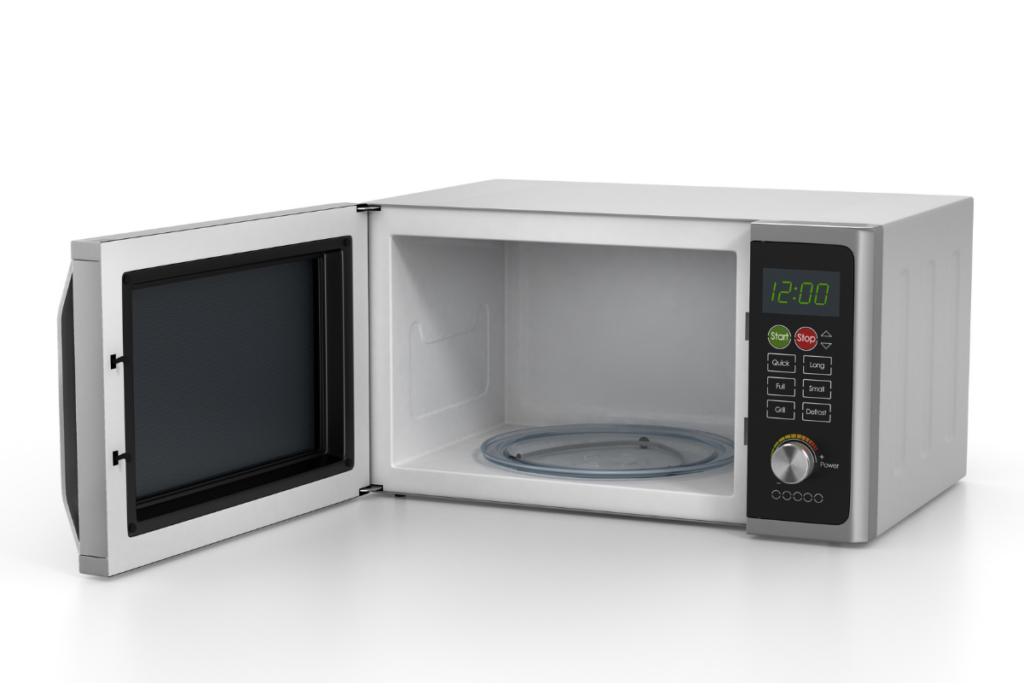
Unfortunately, repairing this problem will require more than just allowing the motor to dry out.
Diagnosis
Chances are you’ll know if water boiled over or spilled in the microwave, but the only way to confirm that the motor has been damaged is by testing it with the multimeter.
To access the turntable motor, unplug the microwave and remove the turntable plate. Rotate the microwave so you access and remove the bottom panel of the microwave. Disconnect any wires that are plugged into the microwave.
Locate the voltage designation on the motor. Plug the microwave back in and turn it on. Use the multimeter to determine how much power is being supplied to the motor. If the voltage is correct, the motor is defective; if no or inadequate voltage is being supplied, the problem is likely not in the motor itself.
Repair
Most turntable motors are relatively inexpensive and can bring an otherwise good microwave back to life.
Remove the defective motor by removing the mounting screws, and disconnecting any wires. Pull the drive shaft out of the hole in the microwave floor, then slide the replacement drive shaft into place. Reattach the wires, and secure the motor by putting the mounting screws back in place.
Make sure you don’t leave loose screws!
Completely reassemble the microwave and put the turntable back in place before plugging back in.
Faulty power outlet or tripped breaker
While most of the problems that might cause your microwave’s fuse to keep blowing are related to internal components, it’s also possible that there is a fault in the power outlet.
A power outlet can be damaged or fail from age or use, causing it to become a fire or safety hazard. It may also supply power in surges, causing the fuse in the microwave to blow.
A faulty part like a power outlet is a major problem and needs to be replaced as soon as possible.
Diagnosis
You will probably be able to tell if there is a major problem with your outlet through a simple visual inspection.
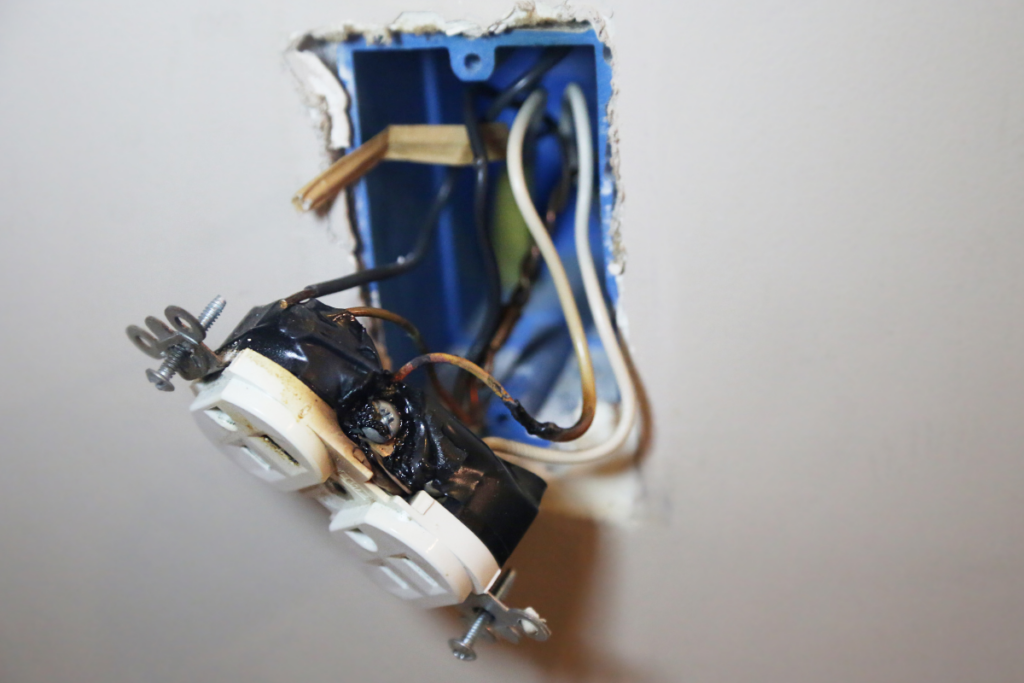
Check the outlet, faceplate, and directly above the outlet for any signs of melting or scorch marks, which will be dark marks leading up from the outlet.
If you see any of these signs, unplug all electronics and stop using the outlet immediately.
Also note that because microwaves draw so much power, it is best to use a dedicated circuit or at least a dedicated outlet for this appliance.
Repair
Replacing a damaged outlet is best done by a certified electrician.
While normally I support changing out outlets and basic installations, it may be worth bringing in a professional who can determine if there is an underlying problem that caused the short circuit.
Signs that a microwave fuse has blown
So, what are the symptoms of a blown microwave fuse?
With the inbuilt fuse blown, the microwave will usually not be able to power up – the display stays blank, the interior light does not come on and there is no beeping sound when the display buttons are pressed.
The fuse blow may be instant or when you press the microwave START button.
What if the microwave display is flickering?
Should you replace a blown fuse in a microwave?
Whether or not it’s worth replacing the blown fuse depends on what caused the fuse to blow, and what other repairs will need to be made to make the microwave functional again.
It depends on the type of fault, and associated costs of parts, and labor.
For example, the turntable motor is relatively easy and inexpensive to replace while replacing the magnetron may actually cost more than a new microwave.
How much does it cost to replace a blown microwave fuse?
Most microwave fuses are relatively inexpensive, but there may be hidden costs in the repair.
Microwave fuses tend to be about $3-4 each and you can do the replacement fuse job yourself if you’re willing to take the microwave apart.
While this is obviously more affordable than replacing the entire microwave, you’ll still need to determine what caused the fuse to blow in the first place. If you don’t already have one, you’ll need to purchase a multimeter to test the individual electrical components.
Closing thoughts on why your microwave fuse keeps blowing
If your microwave fuse keeps blowing, it’s probably because of the:
- High voltage capacitor failure
- High voltage diode failure
- Defective magnetron
- Cooling fan failure
- Defective door switch
- Incorrect or underpowered fuse
- Water in the appliance
- Faulty power outlet
Depending on which of these reasons is causing the fuse to blow, you may be able to repair the microwave, or it may actually be more affordable (and easier!) to simply buy a new one.
Can I Use Any 20 Amp Fuse For My Microwave?
Always use the same type of fuse in your microwave as the one you removed.
Most microwaves use a 20 amp fuse, but they’re not interchangeable.
Should You Use A Fuse With A Higher Amp Rating?
Always use the recommended fuse rating. Do not attempt to use a higher amp fuse as a way to stop the fuse from blowing.
Doing so risks exposing the microwave circuitry to larger and potentially damaging currents than it is designed for that may even cause a fire.
Always fit a fuse with the recommended current rating (amps) and type.
What would cause a fuse to keep blowing?
The most common reasons for a microwave fuse that keeps blowing are an overloaded circuit, a faulty door switch, a damaged transformer, a malfunctioning magnetron, a shorted capacitor, a rectifier or diode failure, damaged wiring, power surges, or simply old age.
Can I use any 20 amp fuse for my microwave?
The type of fuse you should use for your microwave depends on various factors like the specifications mentioned in the user manual, the fuse’s voltage rating, and its fast or slow blow characteristics.
While a 20-amp fuse may fit and even work for a short period, using the incorrect fuse can lead to a risk of electrical fire, damage to the microwave, or other safety hazards.
Let Us Know How We’re Doing!
Did this expertly prepared resource answer your question?
Do you have another question about home maintenance, home improvement projects, home appliance repair, or something else?
Get more information, send in questions and keep the discussion going by contacting the I’ll Just Fix It Myself company customer service team at at 1-800-928-1490 or Email us at [email protected]
