
Best Electric Space Heater for the Garage: Top Picks of 2024

As we navigate the colder months of 2023, finding the best electric space heater for your garage becomes a priority for many. Garages, often used as workshops, hobby spaces, or storage areas, require efficient heating to maintain comfort and functionality. This blog post is dedicated to helping you discover the top electric space heaters for garages this year, focusing on performance, energy efficiency, and suitability for various garage environments.
Importance of Selecting the Right Electric Heater Choosing the right electric space heater is essential for creating a warm and safe environment in your garage. The ideal heater not only provides sufficient warmth but also operates efficiently to keep energy costs in check. Additionally, features like safety mechanisms and durability are crucial for long-term satisfaction and peace of mind.
Key Features of Top Electric Heaters in 2023 In 2023, the best electric space heaters for garages are defined by their heating capacity, energy efficiency, safety features, and user-friendliness. These heaters come in various forms, including convection heaters, radiant heaters, and fan-forced heaters, each with its unique advantages for different garage sizes and insulation levels.
Our Criteria for Selection Our selection of top electric space heaters is based on rigorous analysis of market trends, technological advancements, user reviews, and energy efficiency standards. We aim to provide a well-rounded view, highlighting heaters that excel in both heating performance and energy savings, suitable for a range of garage types, from compact, insulated spaces to larger, less insulated areas.
Join us as we explore the best electric space heaters for garages in 2023. Whether you’re looking for a heater to take the chill off a small space or to evenly warm a large area, our expert picks and insightful tips will guide you to the perfect choice for your needs.
Best Electric Space Heaters for the Garage
As you search for the perfect electric space heater for your garage, we’ve compiled a list of the top options available. Explore these high-quality products to find one that best suits your needs and keeps your garage warm and comfortable.
Shinic Electric Garage Heater

The Shinic Electric Garage Heater is a solid option for those seeking an adjustable, feature-packed heater, but with some minor drawbacks.
Pros
- Remote control and power switch control
- 5 mode settings with light and heat options
- Adjustable 90° heating angle
Cons
- Limited 6-foot power cord length
- Dim 25-watt halogen light
- Some users report light issues
The Shinic Electric Garage Heater is designed for those wanting an effective heating solution for their garage, shop, or large room. With its remote control and power switch control, adjusting the heat settings from 750W to 1500W is easy while keeping the workspace warm. Additionally, the 90° adjustable angle ensures the heat is distributed to the area where it’s needed most.
One of the more notable features of this garage heater is its 5 mode settings, which include various heat settings and a halogen light option. Although the light is somewhat dim at only 25 watts, it does offer some illumination for your workspace. However, some users have reported issues with the light not functioning properly out of the box.
The safety features included in the Shinic heater are noteworthy, such as automatic overheat protection, a grounded plug, metal grill, and ETL listing for safety and quality assurance. Nonetheless, the 6-foot power cord may present a challenge for installation in certain spaces.
Overall, the Shinic Electric Garage Heater is a reliable option for those in need of a versatile heating solution for their garage, despite some minor issues with the light and power cord length.
Shinic Space Heater, 1500-Watt Milkhouse Heater
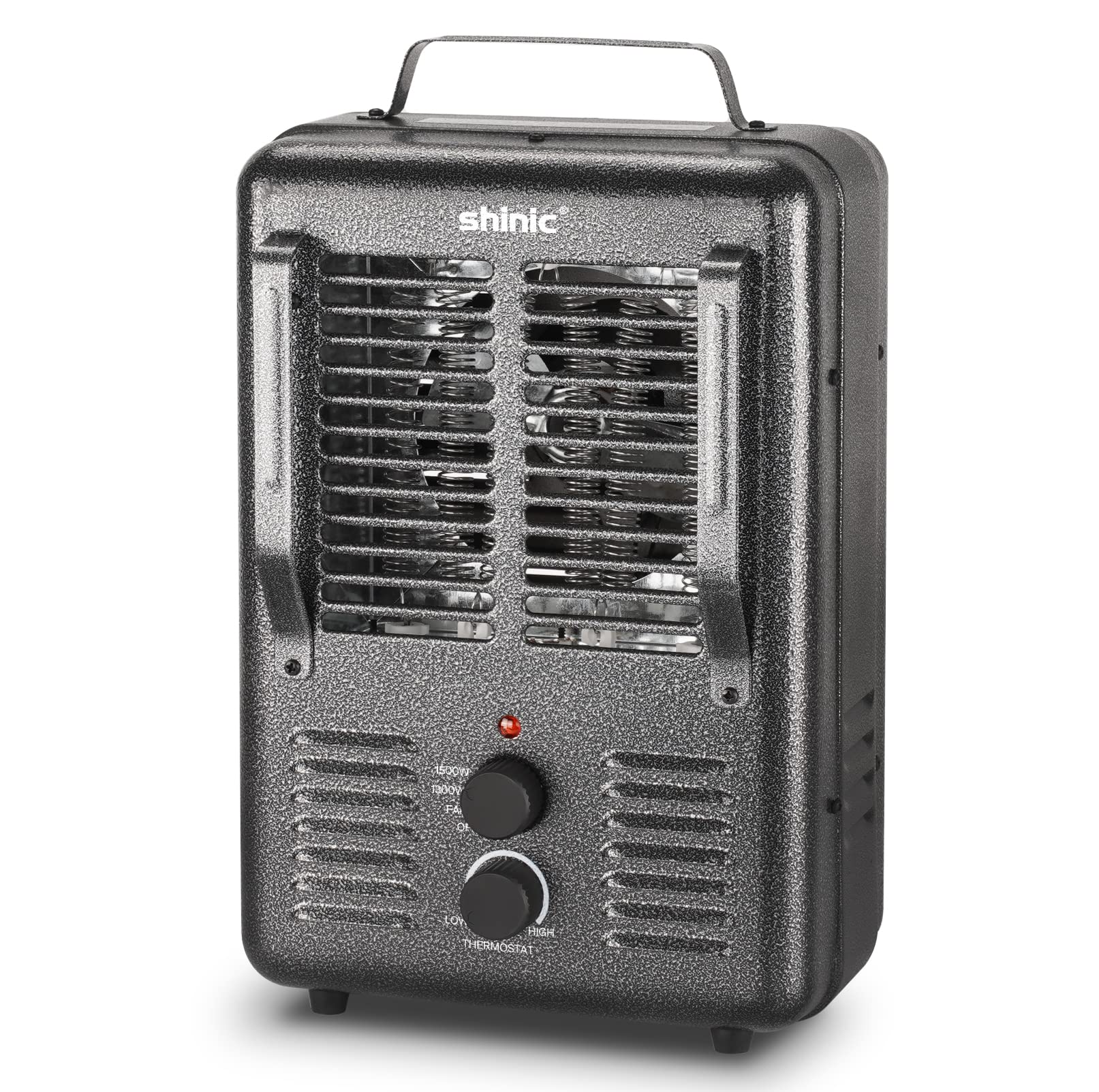
A reliable and efficient choice for heating your garage, the Shinic Space Heater provides quick warmth with advanced safety features.
Pros
- Durable and portable metal housing
- Fast heating with two settings and good coverage
- Safety features including tip-over and overheat protection
Cons
- Large and clunky design
- Noise levels may vary
- May not be suitable for larger spaces
The Shinic Space Heater is designed with durability in mind, featuring a heavy-duty metal housing and a convenient carry handle, ensuring it lasts for years. This heater is portable, allowing you to move it easily from place to place when needed.
With two heat settings, 1500W high-heat mode and 1300W low-heat mode, this heater is efficient, quickly warming your garage up to 200 square feet. Its heating element and powerful fan work together to blow heated air uniformly, making it an ideal choice for small greenhouses and garages.
Safety is incredibly important in any space heater, and the Shinic Space Heater delivers on that front. It has a 3-prong plug for added safety and includes an overheat protection device that automatically shuts off the heater when the internal temperature gets too high. Additionally, a built-in anti-tip device turns off the heater when it is tilted or accidentally dropped to prevent potential fires.
Despite its excellent performance, the Shinic Space Heater does have some drawbacks. Its design is somewhat large and clunky, which may not appeal to those with limited garage space. Noise levels during operation may vary, but many users have reported it being louder than anticipated. Finally, this heater may not be suitable for larger spaces, as its heating capability is limited to 200 square feet.
In conclusion, the Shinic Space Heater is a solid choice for heating smaller garages and greenhouses. Its quick heating, advanced safety features, and portable design make it a dependable option. However, its larger size and noise levels may not suit everyone.
Dreo Smart Wall Heater

The Dreo Smart Wall Heater is a reliable and efficient choice for heating your garage with its smart features and excellent performance.
Pros
- Fast and even heat distribution
- Smart control with app and voice assistant compatibility
- Accurate and adjustable temperature settings
Cons
- May not be suitable for larger garages
- Requires installation
- Might not heat an entire home
The Dreo Smart Wall Heater is designed to provide widespread warmth evenly and efficiently thanks to its 120° wide oscillation heating. You will be impressed with how quickly this heater can bring up the temperature in your garage, making it an ideal space to work in even during chilly winter days.
One of the highlights of this electric space heater is its smart control features. You can schedule heating hours to match your routine and access your heater settings from anywhere using the Dreo app. If you prefer using voice commands, this heater is compatible with both Alexa and Google Home.
When it comes to temperature control, the Dreo Smart Wall Heater offers a wide temperature range from 41 to 95°F, and its 1°F accuracy ensures that you can set the ideal temperature for your comfort. The heater also promises a quieter operation, making it suitable for overnight use without disrupting your sleep.
Please note that this heater may not be suitable for larger garages or for heating an entire home. It is designed for single rooms, like your garage, bedroom, or home office. It also requires installation, which might be a con for some users. However, the package includes all necessary accessories and a convenient drilling guide to facilitate the process.
In conclusion, the Dreo Smart Wall Heater is a great investment if you’re looking for efficient, smart, and accurate heating for your garage. Its user-friendly features and modern design make it a top choice for those who value comfort and convenience.
NewAir Portable Electric Garage Heater (240V)
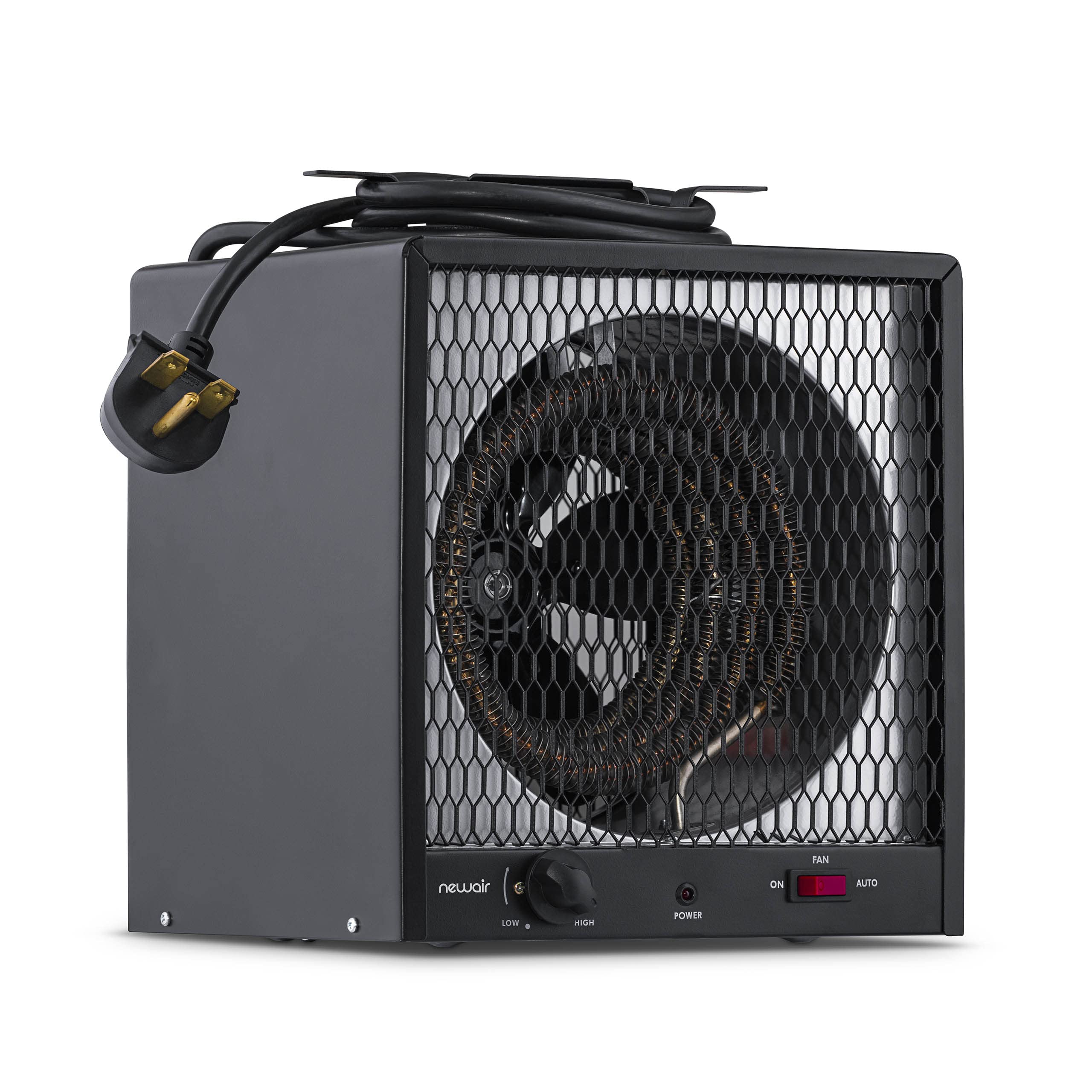
The NewAir Portable Electric Garage Heater is a powerful, highly efficient solution for heating up to 800 square feet of garage or workshop space.
Pros
- Heats up to 800 square feet quickly and evenly
- Portable design with cord wrap and carrying handle
- Rugged exterior and durable construction
Cons
- Requires a dedicated 240-volt outlet
- May be slow to reach desired temperature in larger areas
- No built-in mounting options
The NewAir Portable Electric Garage Heater is designed to provide efficient and even heat distribution in your garage or workshop. With a powerful 5600-watt heating capability and adjustable temperature controls, you can set the desired warmth and let the heater do its job. The fan-forced heating technology ensures even heat distribution throughout the space, allowing you to comfortably work in the dead of winter.
One of the greatest strengths of this heater is its portability. The integrated cord wrap and carrying handle make it easy to move and position the heater exactly where you need it. This versatility ensures optimal warming of your garage, workshop, or shed. The heater is built to last, featuring a rugged exterior capable of withstanding harsh environments and the wear and tear of daily use.
Although the NewAir heater is capable of heating an 800 square feet area, its performance may vary depending on your specific space and insulation quality. It may take longer to reach the desired temperature in larger or poorly insulated areas. Additionally, the heater requires a dedicated 240-volt outlet with 30 amps, which may not be readily available in all garages.
In conclusion, the NewAir Portable Electric Garage Heater is an excellent choice for those seeking a powerful, portable heater for their garage or workshop. Its heating capabilities, portability features, and durable construction make it a reliable option for anyone looking to stay warm during the colder months.
NewAir 2-in-1 Electric Garage Heater

The NewAir 2-in-1 Electric Garage Heater is a versatile and powerful heater, ideal for garages, workshops, and more.
Pros
- Powerful 4,800-watt heating capacity
- Freestanding or mounted design for flexibility
- Remote control for convenient operation
Cons
- Requires a dedicated 240-volt outlet
- May be noisy during operation
- Not suitable for larger spaces beyond 500 square feet
The NewAir 2-in-1 Electric Garage Heater is a reliable solution for anyone wanting to keep their garage or workshop comfortable during the colder months. Its 4,800-watt heating power effectively warms up spaces of up to 500 square feet, making it ideal for a two-car garage or a 20×24 workshop.
This heater provides you with the option of either using it as a freestanding unit placed on the floor or workbench or mounting it to your wall or ceiling with the included bracket. Its rugged shell is designed to withstand tough conditions, ensuring durability and long-lasting performance.
Equipped with a remote control, you can easily control the digital thermostat, choose from two fan speeds, and set the timer to customize your comfort. The heater also has smart safety features including an automatic shut-off function to prevent overheating, as well as a UL-certified 30-amp plug with three prongs to fit a dedicated 240-volt outlet.
One downside to note is that the heater can be noisy during operation, which may be an issue for some users. Also, ensure that you have a dedicated 240-volt outlet available, as this is necessary for the heater’s proper function.
In conclusion, the NewAir 2-in-1 Electric Garage Heater is a great investment for those seeking a versatile, powerful, and convenient heater for their garage or workshop. Despite some noise during operation and the need for a dedicated outlet, its powerful heating capacity and flexible design make it an excellent choice to keep your workspace warm and cozy.
Hykolity Electric Garage Heater

The Hykolity Electric Garage Heater is an ideal choice for efficient and versatile heating suitable for most garage spaces.
Pros
- Efficient heating and energy-saving
- Multiple mounting angles and adjustable airflow
- Convenient dual control via panel and remote
Cons
- Professional electrician required for installation
- Lacks a power cord included
- May not be suitable for smaller garages
After trying out the Hykolity Electric Garage Heater, I can confidently say it delivers powerful heat to the garage space. The built-in thermostat ensures an energy-efficient operation, maintaining a comfortable temperature while cycling on and off. With the overheat protection feature, the heater will automatically turn off if it gets too hot, ensuring safety and long-term usage.
The thoughtful design allows for multiple mounting angles and an adjustable louver for targeted heating where it’s needed most. The heavy-duty steel construction ensures durability, even in spaces with temperature fluctuations. As someone who has used this heater, I can attest to its potential to cut my energy bills down, thanks to the timer function that ranges from 1 to 8 hours.
One drawback is the required hardwired installation. It’s necessary to hire a professional electrician for the setup, adding an extra cost to the purchase. Another con is the absence of a power cord, which could be inconvenient for some users. Lastly, the two heat settings (7500W/25590BTU and 10000W/34100BTU) might not be best suited for smaller garages.
In conclusion, the Hykolity Electric Garage Heater is an excellent choice if you’re looking for an energy-efficient and versatile heating solution for your garage. However, you should consider factors such as professional installation and the lack of a power cord before purchasing. Overall, it’s a solid investment for a comfortable and well-heated garage environment.
Buying Guide
When choosing the best electric space heater for your garage, there are several factors to consider to ensure you have the right product to meet your needs. Here, we’ll discuss some essential features and criteria you should keep in mind while making your decision.
Size and Power: First, consider the size of your garage and how much heating power will be required. This is typically measured in watts or British Thermal Units (BTUs). As a rough guideline, you’ll need about 10 watts of power for every square foot of space. So, if your garage is 200 square feet, you should look for a heater with a capacity of at least 2,000 watts. Keep in mind that higher power will result in more heat output and faster heating.
Safety Features: Safety should always be a priority when purchasing any appliance. Look for space heaters that have safety features like overheat protection, cool-touch exteriors, and tip-over switches. These will help prevent accidents and ensure that your heater operates without posing any risks.
Temperature Control: Choose a heater that offers adjustable temperature settings, so you can control the level of heat. This will enable you to set the ideal temperature for your garage space, making it comfortable and preventing energy wastage.
Energy Efficiency: An energy-efficient heater will save you money on electricity bills in the long run. Look for heaters with features like timers, adjustable thermostats, and energy-saving modes that can help conserve energy when the heater is not in use.
Noise Levels: Depending on your preferences and usage, the noise level of the heater may be an essential factor for you. Generally, electric space heaters are quieter than propane or kerosene-powered heaters. In any case, check the noise level specifications before making a decision.
Portability: Depending on your needs, you might want a heater that’s easy to move around your garage or one that can be mounted on the wall or ceiling. Some heaters have built-in handles, wheels, or brackets for convenient portability and installation.
Remember to take these factors into account when selecting the best electric space heater for your garage. By considering these features, you will be able to find the most suitable product for your needs and ensure a comfortable and warm workspace.
Check Out Our Complete Guide to Space Heaters!
If you enjoyed this post, check out our complete guide to space heaters for more information on space heater types, safety features, troubleshooting common issues, and how to choose the right space heater for your needs!
Let Us Know How We’re Doing!
Did this expertly prepared resource answer your question?
Do you have another question about home maintenance, home improvement projects, home appliance repair, or something else?
Get more information, send in questions and keep the discussion going by contacting the I’ll Just Fix It Myself company customer service team at at 1-800-928-1490 or Email us at [email protected]
